CEBRI participates in international conference on the role of think tanks in Latin American and Caribbean governance
- 25 june 2026
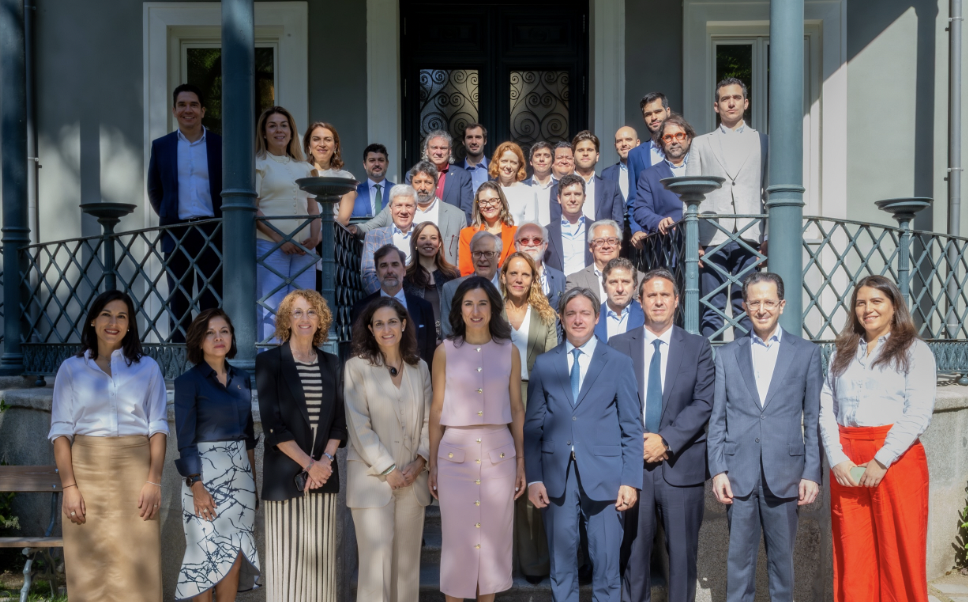
CEBRI participated on June 1 and 2 in the conference "Strategic Dialogue: Think Tanks and Governance for Sustainable Development in Latin America and the Caribbean," held at the Fundación Ortega y Marañón in Madrid.
Promoted by CAF – Development Bank of Latin America and the Caribbean and the United Nations Development Program (UNDP), the event brought together representatives from think tanks in Latin America and Europe to discuss the challenges of democracy, public security, and public policy-making amid the profound transformations underway in the international order.
CEBRI was represented by Manoel Corrêa do Lago, Member of the Academic Advisory Board. The Conference was coordinated by Juan Fernando Londoño, Corporate Vice-President for Strategic Programming at CAF; Michelle Muschett, UNDP Regional Director for Latin America and the Caribbean; and Rebeca Grynspan, Secretary-General of UNCTAD.
Also present were representatives from institutions such as CARI, Austral, and Fundar (Argentina); Fedesarrollo (Colombia); Evalúa (Mexico); Fundação Getulio Vargas – FGV (Brazil); Instituto de Estudios Peruanos (Peru); Chatham House (United Kingdom); ILAS-GIGA (Germany); Real Instituto Elcano and Fundación Avanza (Spain); and IPDAL (Portugal).
Among the main topics discussed was the strengthening of democracy amid growing political polarization. Participants noted that although support for democratic regimes remains predominant in the region, trust in public institutions remains low, reflecting the difficulty governments face in responding to the population's demands. It was also noted that polarization has narrowed the space for evidence-based dialogue, making consensus-building more difficult.
Public security was another central focus of the Conference. In light of the expansion of transnational organized crime, participants discussed how to strengthen states' capacity to provide effective responses, reconciling the efficiency of crime-tackling with the preservation of democratic principles and the rule of law.
The discussions also addressed the challenges faced by think tanks amid growing political complexity and funding constraints. There was consensus on the importance of producing policy-oriented knowledge, turning diagnoses into concrete action proposals, and preserving institutional autonomy as an essential condition for these organizations' credibility.
As a next step, participants advocated strengthening cooperation among the participating think tanks, with support from CAF and UNDP, on research initiatives and knowledge production on topics of common interest, including the joint development of indicators in the area of public security.
The meeting built on discussions begun at the 2nd CEPAS Network Conference, held on May 25 and 26 at CEBRI, in Rio de Janeiro. The participation of several institutions in both events reinforces a shared agenda focused on reflecting on the impacts of global geopolitical reconfiguration on Latin America and the Caribbean and on the role of think tanks in shaping strategic responses for the region.
