
-

-

-
 PT | EN
PT | EN 
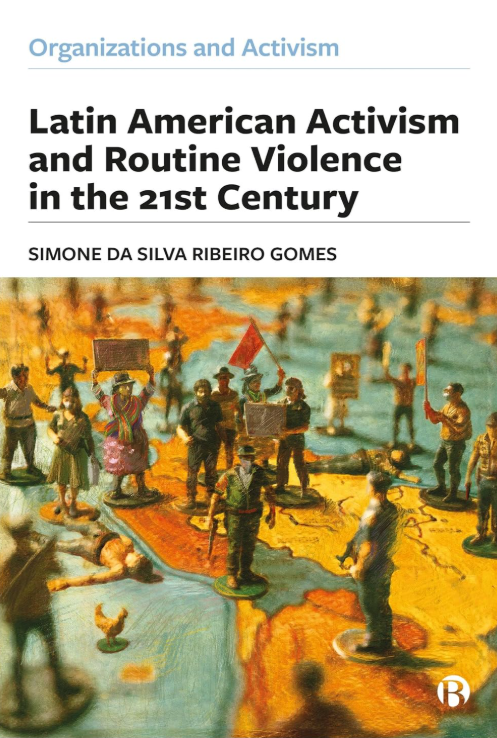
In her book Latin American Activism and Routine Violence in the 21st Century, sociologist Simone Gomes discusses the relationship between how violence is exercised by State and paramilitary actors and the transformations in Latin American activism in the 21st Century. The author demonstrates that the increased repression of activists in the region represents a significant obstacle to social movements, but that this does not mean the complete elimination of collective action and resistance.
This work is the result of extensive research, including interviews with activists and researchers, analysis of quantitative data, and consultation of journalistic materials. Among the book's main contributions, I highlight four: (1) the theoretical debate that broadens the scope of Social Movement Theory; (2) the methodological insights relevant to how we should conceive of Latin America as an object of study; (3) the discussion of historical elements that help deconstruct the widely disseminated discourse that the region is intrinsically violent; and (4) the recording of the names and trajectories of numerous activists and social movements throughout the work, an initiative that helps keep the memory of these individuals alive.
One of the main ideas defended by the author is that violence in Latin America–the most violent region in the world, where the homicide rate is four times higher than the global average–cannot be conceived as a contextual phenomenon, but rather as a structural one. The use of the concept of routine violence signals that the daily lives of these people are strongly marked by violence, and that this violence is not exercised in a monopolized way by the State. Paramilitary actors, often with the tacit or explicit support of state actors and/or sometimes financed by transnational capital, are assuming an increasingly preponderant role in political conflicts. This fact adds another element to be considered in the Theory of Social Movements when researching Latin American societies, something normally ignored in studies of the societies of the world-system's core countries, since in those countries, the State, as a rule, does not outsource the exercise of violence.
The fear generated by the repressive practices of paramilitary groups in Latin American countries results in a significant demobilization of social movements, due to the high risk for certain groups to publicly express their demands. Proof of this is that, in the last 25 years, Latin America has recorded thousands of activists murdered by State security forces, while in Europe, only one such death has been documented. The most vulnerable groups are those comprised of peasants, indigenous people, Afro-Latinos, environmentalists, and feminists, which implies the need to consider the relationship between violence and activism from the intersection of class, gender, and race.
In addition to these structural inequalities, Gomes also draws attention to internal differences within Latin America. The sociologist demonstrates that, although demobilization caused by State and paramilitary repression is a reality in all countries of the region, this phenomenon does not occur uniformly across them. By employing typologies, such as the one that divides countries by the frequency of violence against activists (rare, occasional, and frequent), the author aligns with Waldo Ansaldi's (2022) methodological proposal to consider Latin America as a "heterogeneous collective."
Ansaldi defends the idea of thinking of the region as a totality united by its internal diversity. This implies that "Latin Americanist" researchers, interested in investigating phenomena that transversally affect the countries that make up the subcontinent due to their peripheral position in the world-system and the existing cultural and historical similarities between them, should be careful not to produce absurd generalizations. In other words, Ansaldi warns us of the need to avoid two extremes: (1) the myopia of methodological individualism, which focuses on analyzing social phenomena only from the observation of political conflicts at the national level, and (2) the obsession with arriving at general conclusions about Latin America from the analysis of a limited number of particular cases.
In my view, Gomes finds the optimal point between these two extremes. The author's ambitious project to analyze the transformations in the relationship between violence and activism in 21st-century Latin America is successful because it manages to articulate national and transnational elements in the analysis of the numerous cases of violence faced by activists daily, while also recognizing that these elements affect different countries in different ways and with varying intensities. For example, the author links the rise of paramilitary power to transnational factors, demonstrating that foreign mining companies have partnered with paramilitary groups to suppress environmentalists' actions who resist the advance of extractive industries. This problem is relatively more serious for Amazonian countries, such as Brazil, Colombia, Peru, and Venezuela, than for Uruguay, for instance.
Another interesting contribution of Gomes' work is the questioning of the widely disseminated discourse that Latin American societies are inherently violent, due to a supposed "original sin" produced by European colonization in the 16th Century. This direct link between a distant past and the present prevents us from seeing the decisions of political actors after formal independence that led to the perpetuation of violence to this day. Consequently, it also prevents us from thinking about solutions to break the trajectory of violence.
In contrast to this deterministic conception, Gomes does not ignore the long-term effects of colonization, but rather seeks to incorporate into her analysis the effects of other more recent processes, such as the establishment of authoritarian political regimes and the maintenance of repressive elements even after redemocratization. The author states that in moments of critical conjuncture (economic and/or political crises), elites tend to resort to the militarization of society and politics as the primary means to contain social dissent, historically reinforcing and updating the trajectory of violence in these societies.
Beyond the theoretical and methodological innovations, another aspect of Gomes' work that deserves mention is its contribution to preserving the memory of a large group of activists and social movements. After all, their names and life stories are recounted throughout the work, serving not only as evidence supporting the rich theoretical discussion proposed but also as a repository of mini-biographies that cannot be forgotten.
Finally, it is worth noting that, despite the bleak diagnosis of the reality of social activism in Latin America, it is possible to envision a different future. The author cites a series of resistance and solidarity initiatives that have emerged over the past few decades, offering the reader a dose of hope at the end of the work.
References
Ansaldi, Waldo. 2022. "How to investigate the Latin American enigma? New propositions to capture a very elusive lie". Estudios Latinoamericano , Nueva Época 50 (July-December): 19-50.
Gomes, Simone. 2026. Latin American Activism and Routine Violence in the 21st Century. Bristol University Press.
Received: June 22, 2026
Accepted for publication: June 25, 2026
DOI: https://doi.org/10.54827/issn2764-7897.cebri2026.17.04.01.199-204.en
* Translated by Theo Pereira with the support of digital machine translation tools: Google Translate (initial draft), Grammarly (grammatical and syntactic revision), and ChatGPT (selective phrasing refinements). Reviewed by the author.
Copyright © 2026 CEBRI-Revista. This is an open access article distributed under the terms of the Creative Commons Attribution License, which permits unrestricted use, distribution, and reproduction in any medium, provided the original article is properly cited.