Online events
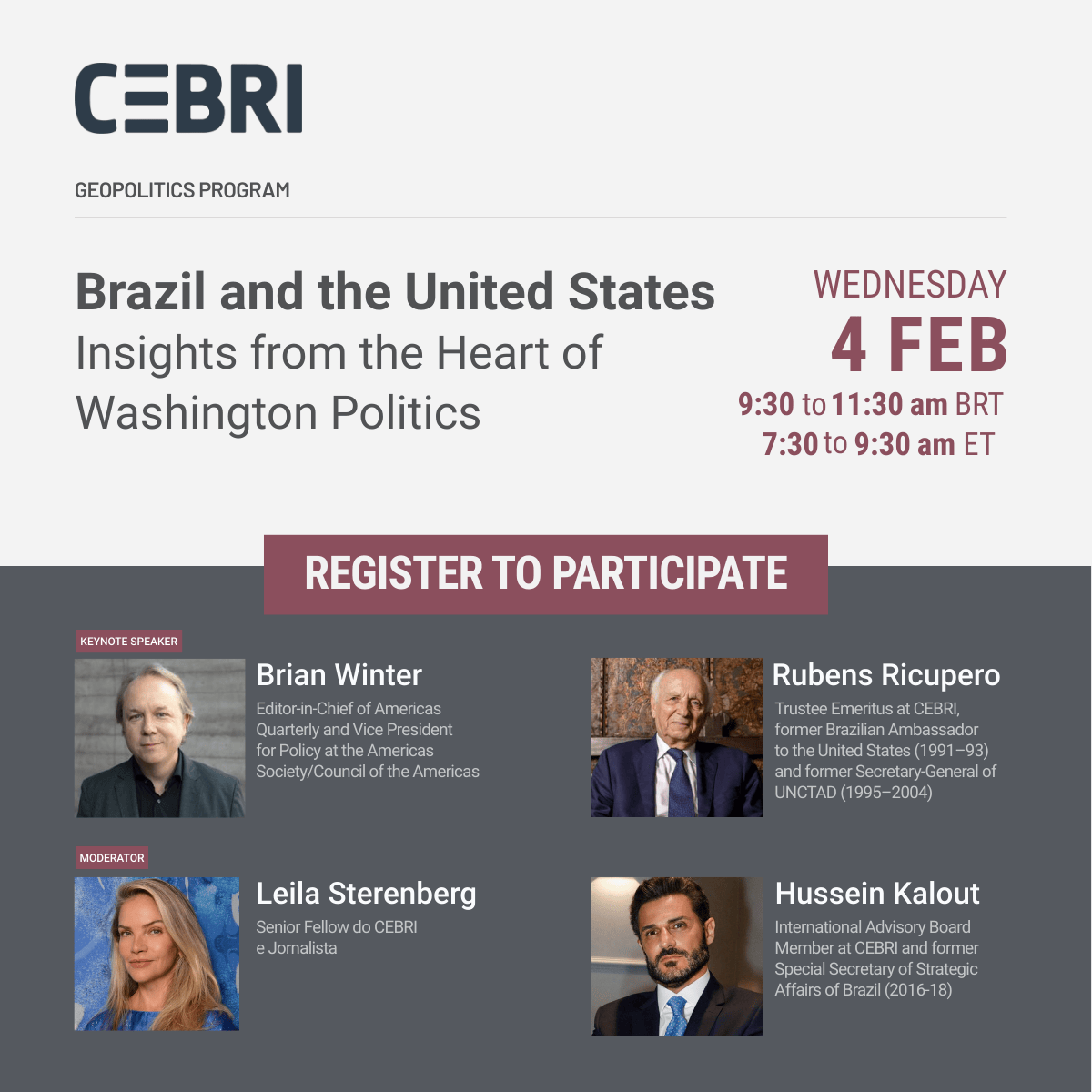
Brazil and United States: Insights from the Heart of Washington Politics
February 4, 2026
The Brazil–United States relationship remains one of the most strategic and multifaceted partnerships in the Western Hemisphere. Political developments in Washington, including actions by Congress, the Executive Branch, think tanks, and other policy actors, directly influence U.S. foreign policy and its implications for Brazil.
Geopolitical competition, global economic transformations, climate change challenges, and debates on democratic governance and regional security mark the current international context. In this scenario, decisions made in Washington can significantly impact strategic sectors in Brazil, including trade, investment, energy, and environmental policies, making close monitoring of these dynamics essential.
This becomes particularly relevant as the new National Security Strategy highlights the strategic importance of the American continent for Washington. The document states that “the United States must be preeminent in the Western Hemisphere as a condition of our security and prosperity…”, signaling a renewed and emphatic focus on regional influence. References that evoke the Monroe Doctrine, including calls to “assert and enforce a ‘Trump Corollary’” to the doctrine, indicate a shift toward a greater U.S. role in hemispheric affairs. In this context, the ongoing crisis in Venezuela can be understood as one of the clearest illustrations of the United States’ evolving approach toward Latin America and the Caribbean.
With Brazil approaching the 2026 presidential election, understanding trends in U.S. politics becomes even more relevant. U.S. policy decisions may intersect with domestic political developments in Brazil, influencing bilateral priorities and government strategies, and directly impacting the country’s international agenda.
The event will focus on current trends in Washington decision-making, the priorities of U.S. policymakers toward Latin America, and potential implications for Brazil.
Date:
February 4, 2026
Time:
9:30 am to 11:30 am (BRT)
Language:
Portuguese
Share
The Brazil–United States relationship remains one of the most strategic and multifaceted partnerships in the Western Hemisphere. Political developments in Washington, including actions by Congress, the Executive Branch, think tanks, and other policy actors, directly influence U.S. foreign policy and its implications for Brazil.
Geopolitical competition, global economic transformations, climate change challenges, and debates on democratic governance and regional security mark the current international context. In this scenario, decisions made in Washington can significantly impact strategic sectors in Brazil, including trade, investment, energy, and environmental policies, making close monitoring of these dynamics essential.
This becomes particularly relevant as the new National Security Strategy highlights the strategic importance of the American continent for Washington. The document states that “the United States must be preeminent in the Western Hemisphere as a condition of our security and prosperity…”, signaling a renewed and emphatic focus on regional influence. References that evoke the Monroe Doctrine, including calls to “assert and enforce a ‘Trump Corollary’” to the doctrine, indicate a shift toward a greater U.S. role in hemispheric affairs. In this context, the ongoing crisis in Venezuela can be understood as one of the clearest illustrations of the United States’ evolving approach toward Latin America and the Caribbean.
With Brazil approaching the 2026 presidential election, understanding trends in U.S. politics becomes even more relevant. U.S. policy decisions may intersect with domestic political developments in Brazil, influencing bilateral priorities and government strategies, and directly impacting the country’s international agenda.
The event will focus on current trends in Washington decision-making, the priorities of U.S. policymakers toward Latin America, and potential implications for Brazil.