
-

-

-
 PT | EN
PT | EN 
This paper discusses the Donroe Doctrine as a contemporary manifestation of the historical link between protectionism and imperialism. Drawing on Karl Polanyi’s metaphor of crustacean nations and Susan Strange’s distinction between structural and relational power, it argues that the US has abandoned institutional power in favor of direct coercion. For Brazil, sovereign survival will depend on leveraging its economic interdependence as relational counterpower.
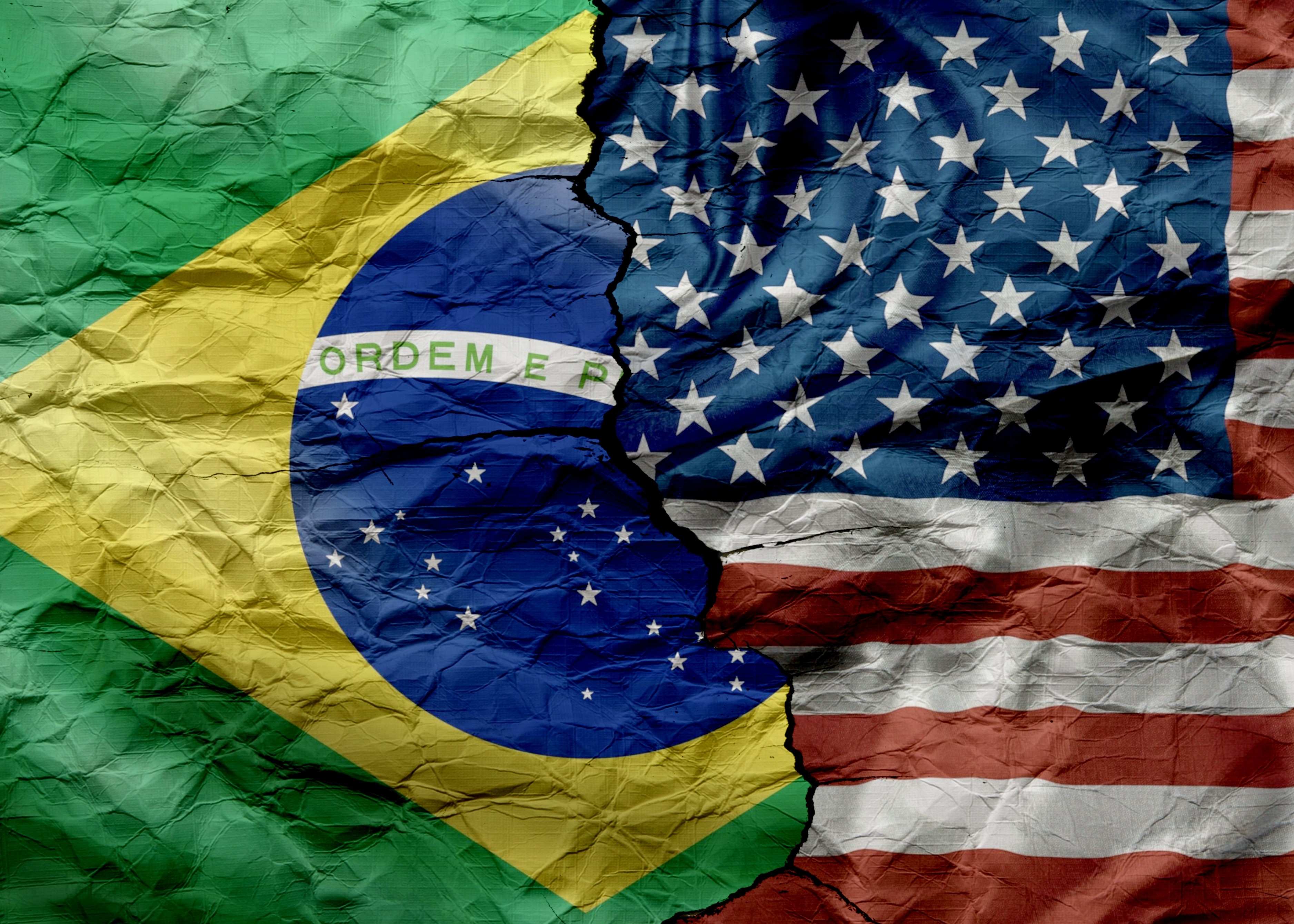
The year 2026 began with the United States invading Venezuela to capture Nicolás Maduro, threatening to annex Greenland (a Danish territory and therefore part of NATO), maintaining widespread tariffs on allies and adversaries, and having bombed Iranian nuclear facilities six months earlier. The Trump administration withdrew the US from the WHO and the Paris Agreement, closed USAID, and drastically reduced funding to multilateral agencies. With its 2025 National Security Strategy, the Trump Corollary formalized the Donroe Doctrine [1] a contemporary, more aggressive version of the Monroe Doctrine that treats the Western Hemisphere as an American sphere of influence and prioritizes its consolidation before any direct confrontation with China.
In 2021, I published an article through the Brazilian Center for International Relations (CEBRI), part of a project supported by the Konrad-Adenauer-Stiftung (KAS), analyzing the political economy of technological innovation strategies (Penna 2021; see also Penna 2020). Using Polanyi's concept of the double movement–the oscillation between periods of market liberalization and periods of social protection and state intervention–I argued that we were entering a phase of a return to active industrial policy, the renationalization of value chains, the pursuit of technological sovereignty, and the decline of multilateral governance. The pandemic had catalyzed trends that had been gestating since the 2008 financial crisis and the rise of China.
The diagnosis was correct. Trump's widespread tariffs, export controls on semiconductors, and explicit industrial policy (which Biden had already deepened with the CHIPS Act and the IRA)–all of this confirms the Polanyian shift the article identified.
My moderate optimism regarding the possibility of institutional inertia within liberalism and multilateralism has, however, proven misguided. In the 2021 article, there was an implicit hope that liberal-multilateral forces would offer some resistance to institutional rupture, especially within the European context. There was an expectation that US-China competition would be costly and therefore occur within certain limits–trade disputes, technological wars, but not direct military intervention in sovereign states nor threats of territorial annexation against allies.
Europe is resisting–Operation Arctic Endurance in Greenland, the joint statements–but from a much weaker position than I had imagined. Europe's dependence on the US in matters of security and technology severely limits the space for real and effective resistance.
THE RETURN OF THE CRUSTACEAN NATIONS
My analysis overlooked a fundamental aspect of Polanyi's argument in The Great Transformation (Polanyi 2021 [1944]): the imperialism of the late nineteenth and early twentieth centuries was, precisely, an attempt to circumvent the limitations of the self-regulating market. The counter-movement of protection and economic sovereignty comes accompanied by territorial expansionism–not as a simple causal relationship, but as a simultaneous and dialectical dynamic.
As countries adopted protectionist measures (tariffs, labor laws) to protect their societies from the destruction caused by the free market, international trade would stagnate. In plain words: 19th-century protectionism went hand in hand with imperialism. We are seeing a contemporary version of this. Under Trump, the tactic changes: this link reappears, now combined with the deliberate abandonment of institutional power in favor of direct coercion–including over allies.
Paradoxically–since, theoretically, free trade should be an anti-imperialist and peaceful force–this dynamic definitively buries the neoliberal utopia that unrestricted trade would be a vector of peace. Where the market fails to guarantee access to rare earths in Greenland or oil in Venezuela, military power steps in to fill the vacuum. What we observe today is the realization of Polanyi's warning about nations becoming crustacean units: sovereign entities with hard shells and militarized borders, whose interactions cease to be fluid exchange and become physical clashes. The image, which Polanyi used to describe the fragmentation of the international system after the collapse of the gold standard, applies with renewed force to the present. The Donroe Doctrine is the fullest manifestation of this "crustaceanization".
Finally, the last bulwark identified by Polanyi has broken: haute finance. During the Hundred Years' Peace, international finance capital acted as a brake on imperial ambitions, moderating conflicts to preserve asset value and exchange rate fluidity. Not that high finance was neutral–it had its own interests and pursued them relentlessly. However, these interests coincided with the moderation of conflicts that destroy assets, disrupt trade flows, and create monetary instability. In 2026, this coincidence dissolved, drastically weakening the moderating function. The financial system, far from being a supranational peacemaker, was instrumentalized as a geopolitical weapon. The expropriation of reserves, the use of the dollar as a coercive instrument, and the fragmentation of payment systems demonstrate that finance has lost its role as a relatively autonomous arbiter of interstate politics. Without the financial buffer and with the market hampered by protectionism, the path to a direct hegemonic conflict is, tragically, unobstructed.
Although Trump's moves and statements shock some, they should not be surprising, as they are consistent with the great US strategic doctrine. As Padula (2025) points out, since Mahan and Spykman, the US has treated control of the Greater Caribbean (American Mediterranean) and transoceanic islands as security imperatives–a pattern that dates back to the annexation of Hawaii and today extends to Greenland [2]. Venezuela has always been a strategic enclave in the North-South American arc; Greenland, an advanced position in the North Atlantic.
This logic of military security is inseparable from a crucial geoeconomic dimension, even if the latter remains subordinate to the geopolitical imperative. Direct control over Greenland aims to guarantee the rare-earth elements essential to semiconductor and advanced battery production; intervention in Venezuela seeks to secure heavy-oil reserves amid a fragmented supply chain. American industrial policy, therefore, has ceased to be merely about subsidies and tariffs (as in the CHIPS Act and the IRA ) and has become a policy of physical appropriation of inputs. If economic resources are the means, the denial of these resources to China and the self-sufficiency of Fortress America are the end.
BETTING ON RELATIONAL POWER
It can be argued that, behind these seemingly erratic movements, there is a strategic thread of reaffirmation–if not recovery–of United States global power. If Polanyi offers us the historical perspective on strategy, Strange offers us a lens [3] to dissect Trump's tactics: the distinction between structural power and relational power (Strange 1988; 1987).
Structural power is the ability to shape the structures in which other actors operate–defining the rules of the game that shape the conditions of security, production, credit, and knowledge in which international politics unfolds. It is the power that the United States has built and maintained since World War II and the Bretton Woods Conference: the IMF, the World Bank, GATT/WTO, NATO, the alliance system, the intellectual property regime, and even the United Nations. This power is a multiplier: it allows the projection of influence at a relatively low cost and creates dependencies of origin and lock-ins that favor those who designed the rules.
Relational power, on the other hand, is more direct: the ability to make another actor do something they would not otherwise do, through coercion, threat, or reward. It is the power of the stronger over the weaker in each specific interaction.
Trump is deliberately abandoning structural-institutional power in favor of pure relational power. The withdrawal from multilateral organizations, the disregard for historical alliances, the direct threats to allies, the very incursion into Venezuela as a show of force–all this represents a trade-off that most analysts would consider irrational from the perspective of long-term American interests. However, the bet seems to be that institutional power was already eroding, whether due to the rise of China, the weakening of the institutions themselves, or the domestic perception that the US was paying the price without proportional return. There are, therefore, two levels of analysis: at the structural level, the institutions were already losing effectiveness; at the agency level, Trump chose to accelerate this process rather than try to reverse it, betting on capitalizing on the military and economic advantage while it persists.
The problem with pure relational power is that it requires constant maintenance. Every interaction needs to be reaffirmed, either through threats or rewards. There is no institutional inertia working in its favor. And it creates incentives for other actors to seek alternatives: exactly what China and, in a way, the BRICS group offer, albeit imperfectly.
More seriously: relational power based on military coercion works as long as there is no serious resistance. Venezuela had no way to resist. Greenland, protected by NATO (of which the US is the pillar), presents a paradox that could destroy the alliance itself. Furthermore, countries like Brazil, which are neither unconditional allies nor declared enemies, are in an uncomfortable position–any non-aligned movement may be interpreted as a challenge.
What are the likely consequences of this scenario? On the international stage, fragmentation is accelerating. A Sino-equivalent order will not replace the liberal institutional order. China has neither the interest nor the capacity to provide global public goods on the same scale as the US has over the last eight decades. The most likely outcome is a more transactional system, with fewer integrated regional blocs, and the increasingly frequent use of economic and military coercion without smokescreens.
IMPLICATIONS FOR BRAZIL
For Brazil and South America, the drums of war are beating ever closer. The intervention in Venezuela set a precedent. The Donroe Doctrine is explicit about keeping the hemisphere free from hostile foreign incursions–and the definition of hostile is Washington's prerogative. The United States will increasingly view the Chinese presence in regional infrastructure and trade as a threat. The territorialist logic of classic US geostrategy does not exclude Brazil [4].
Faced with this pressure, Brazil relies on the deterrent effect of its own political and economic geography: it is too vast a country for direct intervention and sufficiently globally integrated to be treated as a pariah. The failure of the attempt to impose tariffs on Brazilian products, which forced the White House to a pragmatic retreat, proves that economic interdependence still serves as a shield. However, realism is necessary: our current geoeconomic stature offers some protection, but not geopolitical immunity.
The space for an independent foreign policy is narrowing. The Brazilian dilemma goes beyond the old dichotomy between alignment and autonomy. In a world of crustacean nations and purely relational power, neutrality ceases to be a diplomatic shield and becomes a strategic target. Washington will no longer demand only commercial preferential treatment, but also logistical and territorial submission. The fall of Venezuela proved that the greatest military power in South America does not guarantee sovereignty in the face of imperial determination.
For Brazil, resistance will not come from brute force or from a declarative diplomacy that appeals to a multilateral order that Trump deliberately dismantled. It will come from a strategy of calculated asymmetry that instrumentalizes our potential for interdependence. Venezuela, despite its arsenals, was an isolated economy, under sanctions for years, with limited insertion in global production chains. Brazil is different: its economy intertwines with the American and global economies, and a rupture would have concrete costs for the US itself. Our sovereign survival will depend on our capacity to exercise a relational counterpower: making Brazilian cooperation vital–in energy, critical minerals, food, regional stability–and American imperialism prohibitively expensive.
In this scenario, Brazilian diplomacy acquires a function distinct from the multilateralist tradition that established it. It is not about abandoning it, but about reorienting it: less of a grandstanding, more of a trench warfare strategy. The objective ceases to be the construction of normative consensus in depleted forums, becoming the patient weaving of bilateral and regional commitments that increase the costs of any coercive adventure. This approach requires strengthening Brazil's presence in its neighbors' production chains, negotiating investment agreements that create fait accompli, and maintaining open channels with Beijing and Brussels, not as a provocation, but as a demonstration that Brazil has alternatives. Diplomacy, in this register, is not a substitute for economic power–it is its multiplier.
Preserving room for maneuver requires converting two fronts into trenches: the depth of our insertion into American supply chains and the density of our regional articulation. Brazil must consolidate itself as the master geoeconomic and political link that, if broken, would disrupt not only the supply of the North but also the hemisphere itself. Faced with a hegemon that has decided to devour its periphery, the only effective defense is to be a crustacean too spiny to swallow.
*The opinions expressed in this article are the sole responsibility of the author.
Notes
[1] Coined satirically on the cover of the tabloid New York Post in January 2025, the term was later appropriated by Trump (in January 2026, after the military operation in Venezuela) to describe his policy of hegemonic consolidation in the American Continent and the Western Hemisphere.
[2] For a summary of the historical parallels between Hawaii and Greenland, see Lino's report (2026).
[3] I owe the insight to Professor Juliano da Silva Cortinhas (UnB), who raised it in conversation.
[4] In May 2025, the DefesaNet website revealed efforts by Republican diplomats to obtain unrestricted use of Fernando de Noronha Airport and Natal Air Base (DefesaNet 2025), arguing a historical right of operational return (the same argument used to claim the Panama Canal). Together, these positions would complete an Atlantic containment arc that would complement the American network of bases in Ascension, São Tomé, and Dakar.
Bibliographic References
DefesaNet. 2025. “US orchestrates strategic access to Fernando de Noronha and Natal under the guise of historical rights and military investment”. DefesaNet, May 7, 2025. https://www.defesanet.com.br/geopolitica/agenda-trump/eua-articulam-acesso-estrategico-a-fernando-de-noronha-e-natal-sob-alegacao-de-direito-historico-e-investimento-belico/ .
Lino, Flávio. 2026. “Ghost of the end of independent Hawaii haunts Greenland.” O Globo, January 25, 2026. https://oglobo.globo.com/mundo/noticia/2026/01/25/fantasma-do-fim-do-havai-independente-assombra-groenlandia.ghtml .
Padula, Rafael. 2025. “Venezuela and Greenland: the bigger US plan”. Outras Palavras , January 14, 2025. https://outraspalavras.net/geopoliticaeguerra/venezuela-e-groenlandia-o-plano-maior-dos-eua/ .
Penna, Caetano CR 2020. “Geopolitics and the Economics of Innovation”. CEBRI Policy Paper 2/5. Rio de Janeiro: CEBRI & KAS.
Penna, Caetano CR 2021. "A 'New' Political Economy of Technological Innovation Strategies in the Post-Pandemic World?" CEBRI Policy Paper 3/4. Rio de Janeiro: CEBRI & KAS.
Polanyi, Karl. 2001 [1944]. The Great Transformation: The Origins of Our Time. Boston, MA: Beacon Press.
Strange, Susan. 1987. “The Persistent Myth of Lost Hegemony.” International Organization 41 (4): 551–574.
Strange, Susan. 1988. States and Markets. London: Pinter Publishers.
Received: January 30, 2026
Accepted for publication: March 2, 2026
Translation published: June 9, 2026
* Translated by Theo Pereira with the support of digital machine translation tools: Google Translate (initial draft), Grammarly (grammatical and syntactic revision), and ChatGPT (selective phrasing refinements). Reviewed by the author.
Copyright © 2026 CEBRI-Revista. This is an open access article distributed under the terms of the Creative Commons Attribution License, which permits unrestricted use, distribution, and reproduction in any medium, provided the original article is properly cited.
