
-

-

-
 PT | EN
The political historiography of the Brazilian military dictatorship has a long history, even without considering the political chronicles written by journalists, who, in their own way, established the chain of events and political processes that led to the coup and the intensification of the authoritarian regime. The academic community addressed the topic early on, when the euphoria surrounding the coup was still in the air. From the 1960s, when Octavio Ianni published his pioneering work, until the 1990s, sociologists and political scientists established a political historiography of the coup and the Brazilian military regime. Professional historians concentrated on themes such as the armed struggle, cultural resistance, and the structure of repression, but, strictly speaking, until the turn of the century, they produced little in the field of political history stricto sensu, that is, on the structures, institutions, and figures that played a leading role in the coup and marked the regime as such. In my opinion, this historiography produced by the social sciences has made important conceptual and analytical gains. Still, it has failed to capture nuances of Brazilian political life, neglected the contradictions of certain actors, and failed to grasp the diachronic aspects that mitigate the rigidity of the institutionalist perspective, not to mention the little attention given to the interpretative traps contained in primary sources. After all, one of the rules of historiography is always to distrust its sources.
The work of Brazilianist Thomas Skidmore, published in the late 1980s, was the first major, truly historiographical synthesis on the Brazilian dictatorship, produced by a professional historian. In truth, Hélio Silva–who did not have a degree in History but produced a significant body of work in the field, heavily marked by factual and journalistic narratives–had already published a work focused on the mid-1970s coup. Later, the publication of Elio Gaspari's monumental collection was another landmark in the political history of the coup and the regime, but his perspective–despite the previously unpublished sources consulted–remained captive to a palace-style journalistic chronicle, without problematizing the perspective of the individuals who produced the main documents used, namely, the Geisel-Golbery duo.
Between the commemorations of the 50th and 60th anniversaries of the 1964 coup, there was a publishing boom in political history of the period, with several articles and books by historians such as Carlos Fico, Jorge Ferreira, Rodrigo Patto and Heloisa Starling, among others. The perspective of these authors was less committed to the economic determinants of political processes or to the institutionalist theories that dominated the debate, thereby, to a certain extent, diminishing the conflicts, ideologies, and projects that lay at the root of the coup and the dictatorship. Obviously, none of them intended to return to the positivist myopia that limited history to a succession of facts and names in political life. But their work demonstrated that, even respecting the structural determinants that govern political and social life, the field of political history could help to understand how structures and institutions translate into the experiences and consciousness of actors about their time, a fundamental element to comprehend how defeats and victories, omissions and actions, memories and forgetfulness also mark the march of history.
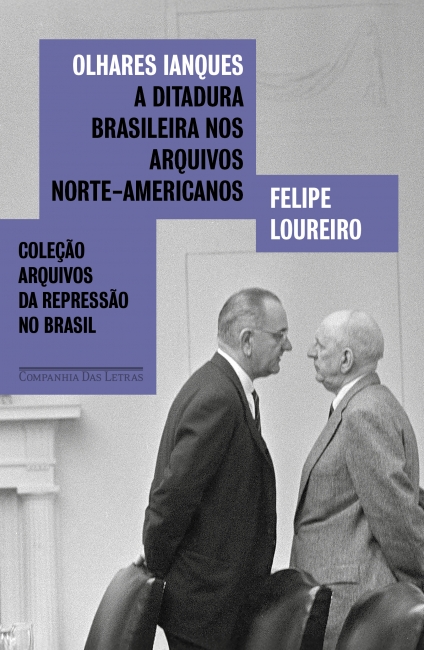
The book by Felipe Loureiro, PhD in Economic History and professor at the Institute of International Relations at USP (University of São Paulo), engages with this renewed interest in political history, proposing, however, an original perspective grounded in previously unpublished primary sources from the US government and American diplomacy. The work is structured into 14 parts (a prologue, 12 chapters, an epilogue), through which Loureiro constructs a fluid, interconnected narrative in chronological order, without limiting himself to a tedious exposition of political and palace events. The book's coverage is worthy of the best historiographical syntheses, spanning from the coup d'état to redemocratization. Given that the work is part of a collection whose editorial line is guided by the use of little-explored primary sources, conceived as a cohesive documentary corpus, it is understandable why some historiographical debates are in the endnotes, with the main text focused on the narrative of political events and processes as seen through the eyes of American diplomats and spies.
While many of the events analyzed throughout the book were already known to the public memory and examined by previous historiography, in Loureiro's book they gain new nuances, informational gaps are filled, especially regarding the establishment of the regime and the moments of government transition of the generals, which, in my opinion, provide the best analytical passages in the work. Based on American documents, always guided by behind-the-scenes information and reduced scales of observation, the political disputes between the military, between the military and civilians, between the Executive and Legislative branches, between technocrats and businessmen, between repression and social movements are revealed to be more complex than imagined, going beyond the games between "hardliners" and "moderates," between government and opposition. In this sense, the book helps to overcome approaches to the dictatorship that are heavily based on simplistic analytical dichotomies, the frameworks of hegemonic social memory, and imprecise adjectives about the nature of the regime. By proposing this nuanced analysis of events, the author manages to avoid falling into relativism and revisionism, which often risk downplaying the authoritarian and violent nature of the dictatorship.
Loureiro's book enriches a field of study dominated by authors such as Luiz Alberto Moniz Bandeira, Carlos Fico, and James Green, with whom he engages in dialogue. Although the work is neither purely theoretical nor a historiographical overview, some gaps go unnoticed. The main one is Ruth Leacock's book on the relations between the United States and the initial phase of the Brazilian dictatorship. André Godoy Ponce's thesis on the presidential diplomacy of Médici and Nixon could also be included in the notes.
As a refined historian, Loureiro always critically examines the statements of American diplomats and spies recorded in hundreds of reports, memos, and telegrams that constitute the impressive body of primary sources he draws upon. However, in some passages, I felt a lack of deeper critical analysis of the diplomats' perspective, especially regarding the regime's repressive policies. The same is true for documentation originating from the intelligence service, particularly the CIA, whose heuristic nature oscillates between more direct and insightful analyses (compared to those of the diplomats) and narratives that indulge in suspicion and see conspiracies that do not exist. Furthermore, the relative increase in sources produced by the CIA compared to those produced by the diplomatic corps in the analysis of the final years of the dictatorship is curious–an aspect pointed out by the author, but one that could be further explored and problematized. The strong bilateral tensions generated by the Nuclear Agreement between Brazil and Germany, evident in the cross-referenced diplomatic documentation among the US, Brazil, and West Germany, already available online, could receive more attention, as they are mentioned only briefly in Chapter 11. The role of the CIA in the reorganization of the Brazilian repressive system after the kidnapping of the US ambassador in 1969 is another topic that could also be explored in greater depth.
These observations about the book's minor shortcomings do not diminish its importance as a historiographical contribution and essential reading in the fields of international relations and political history. Olhares ianques illuminates little-known archives and documents, systematically analyzed in the work, which serve both as a basis for comparison with established perspectives and as suggestions for new research agendas and for information on the political history of the dictatorship. Despite the numerous "black marks" that this declassified documentation still possesses, Loureiro makes them illuminate the shadows of the generals' regime and its State secrets.
References
Loureiro, Felipe. 2026. Olhares ianques: a ditadura brasileira nos arquivos norte-americanos. Coleção Arquivos da Repressão. São Paulo: Companhia das Letras.
Submitted: July 31, 2026
Accepted for publication: August 25, 2026
Copyright © 2026 CEBRI-Journal. This is an Open Access article distributed under the terms of the Creative Commons Attribution License, which permits unrestricted use, distribution, and reproduction in any medium, provided the original article is properly cited.