

-

-

-
 PT | EN
PT | EN 
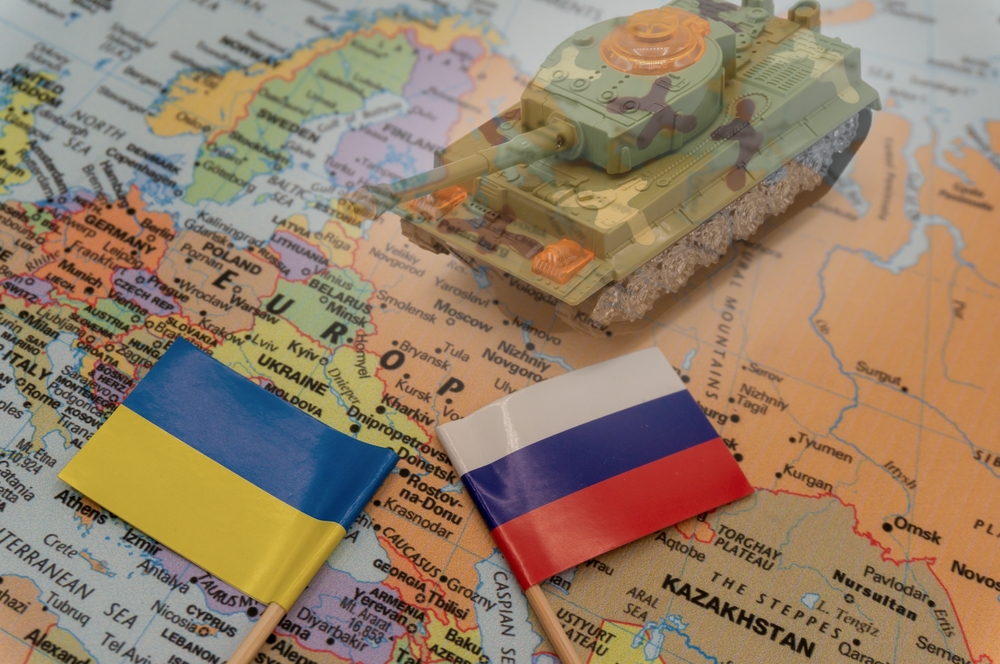
The Russian invasion of Ukraine, which began on February 24, 2022, will represent a watershed moment in the history of 21st-century international relations. While conflicts on the European continent have been nothing new in the post-Cold War era–see the cases of the disintegration of Yugoslavia (1992-1995), the war in Kosovo in 1999, and the Russian invasions of Georgia in 2008 and Ukraine itself in 2014 (Crimea Peninsula and Donbass region)–the current conflict has a distinct nature and, therefore, distinct implications for international security.
This is not only a war of greater dimensions in terms of military mobilization and humanitarian implications regarding refugees, relative to the time elapsed since the conflict began. In reality, given the geopolitical centrality of Ukraine for Russia and NATO, as well as the possibility of an overflow of hostilities–now or in the near future–to other regions of the European continent, especially to members of the US military alliance, the war in Ukraine potentially constitutes one of the rare cases of what William Sewell Jr. called "structural events" (2006, chap. 8), that is, events that have the power to transform long-term structures in the international system, acting as triggers for latent changes.
In this text, I will analyze what seem to me to be the most likely paths and scenarios for the unfolding of the conflict in Ukraine, as well as discuss the evolution of the European and global security landscape in a post-Russian invasion context. I start from the premise that any analysis of the war between Kiev and Moscow needs to take into account not only the various temporal layers that constitute the roots of the divergences between the two countries, but also consider the variety of actors (from post-Soviet states to the European Union and the United States) and different levels of analysis (local, national, international, transnational) involved in the way the conflict has been unfolding and its consequences for the international order.
The immediate roots of the war between Russia and Ukraine date back to the end of the Cold War, becoming evident from the moment when Kyiv gained independence from the former Soviet Union in December 1991. Since then, two perspectives have clashed. On Russia's part, driven by grief over the loss of a geopolitical reality consolidated throughout the 20th century, the need to restore a Ukraine economically and militarily subordinate to Moscow was assumed natural. On the part of Ukraine, the independence of 1991 was understood as the realization of a long-awaited political self-determination, stifled in the post-World War I period by the impossibility of unifying the western and eastern portions of the country, unlike what happened with several regions of Eastern Europe that were part of the defunct Russian, German, and especially Austro-Hungarian empires (Yekelchyk 2020, 126-32).
Even when Russia and Ukraine coincided in presenting leaders seen as pro-Western and pro-Russian, respectively, as in the case of Presidents Boris Yeltsin and the two Leonids in Kyiv (Leonid Kravchuk and Leonid Kuchma), for example–which, in theory, could have enabled a more harmonious coexistence between the parties–the conflict over the status of Ukraine remained present, which points to the existence of structural characteristics in the divergence between Kyiv and Moscow (D'Anieri 2019, chap. 2).
In fact, until the start of the war in 2014, when Russia invaded the Crimean Peninsula and began supporting (though never recognizing) separatist groups in the Donbas region, a certain pattern can be seen in Ukrainian politics: all leaders initially characterized as pro-Russian came to be identified by Moscow and the ethnic Russian community within Ukraine as opposed to Russia. This was true, for example, for Presidents Leonid Kravchuk (1991-1994), Leonid Kuchma (1994-2005), and even the current president, Volodymyr Zelensky (2019)–Zelensky was even accused of being a Moscow agent in the 2019 presidential campaign by the then-candidate for re-election, Petro Poroshenko (Kuzminska 2020, 65–66). At certain times, even President Viktor Yanukovych (2010-2014), considered the most pro-Russian of Ukrainian presidents since the country's independence and who would be overthrown in February 2014 after refusing, at the last minute, to sign an agreement with the European Union, would suffer accusations from Russia of being excessively lenient towards the West (D'Anieri 2019, 184-85).
The reason for this structural tension in the relationship between Ukrainian and Russian leaders, even among those initially more inclined to dialogue with Moscow, lies in the structural divergence regarding Ukraine's status as a country: no Ukrainian president has shown himself to be Russophile enough to accept what Moscow understood as a natural occurrence–a Ukraine under uncontested Moscow hegemony.
This explains why the relationship between Russia and Ukraine has been marked, since the initial moments after Kyiv's independence, by a spiral of security dilemmas. Russian actions aimed at limiting, constraining, or threatening Ukrainian integrity and sovereignty tended to produce impulses for Kyiv to move closer to the West, whether with the European Union or, above all, with NATO–the American military alliance created at the beginning of the Cold War in 1949. This was the case, for example, of the famous Masandra meeting in September 1993, when Russian President Boris Yeltsin threatened to cut off gas supplies to Ukraine if Kyiv refused to accept Russian sovereignty over the Sevastopol naval base and ceased handing over its nuclear weapons and Black Sea fleet to Russia (D'Anieri 2019, 41-42).
As the example of Masandra demonstrates, the serious disagreements between Kyiv and Moscow began even before Washington concluded that NATO should expand into Eastern Europe, something that was consolidated especially from the second year of the Clinton administration, in 1994, with the weakening of the so-called "Partnership for Peace" (Sarotte 2021, 198-227). Once Washington made this decision, however, the spiral of the security dilemma between Russia and Ukraine, already significant, became much more serious, being placed in a context not only of a strategic geopolitical loss (Ukraine) that Moscow had experienced–and did not accept–at the end of the Cold War, but of a defeat that could potentially be even greater for Russia, insofar as areas of the former Soviet sphere of influence, especially Ukraine, would begin to see NATO as the main solution to their security problems vis-à-vis Moscow, consequently exacerbating the sense of serious prejudice and insecurity in Russia.
It is not that Moscow and Kyiv have ceased seeking possible solutions to the security dilemma they face. Ukraine took two fundamental steps in this direction in the 1990s. The first, under strong pressure from the United States, was the signing of the 1994 Budapest Memorandum. With it, Kyiv renounced its nuclear arsenal–then the third largest in the world, a relic of the former Soviet Union–in exchange for a guarantee of recognition of its territorial integrity and sovereignty by Russia, a treaty to which the United States and Great Britain were also signatories (later joined by China and France). In 1997, another important concession was made: in exchange for the division of the Black Sea fleet and the ratification, in a bilateral treaty, of Russian recognition of Ukrainian territorial integrity and sovereignty, Kyiv agreed to leave the strategic port of Sevastopol, on the Crimean Peninsula, under Russian lease until 2017–Ukrainian President Yanukovych, in exchange for better prices for the purchase of Russian gas, would extend this lease until 2049 with the so-called Kharkiv agreements of 2010 (D'Anieri 2019, 65-101, 182-83).
However, as conflicts regarding Ukraine's status vis-à-vis Russia did not end after the signing of these agreements, Kyiv maintained its policy of continuous rapprochement with the European Union and NATO, aiming to employ the American military umbrella in Europe as insurance against possible Russian incursions. Moreover, with each Ukrainian step in this direction, coupled with the process of NATO expansion among the countries of the former Warsaw Pact (1999), and especially towards former Soviet republics (the Baltic countries, in 2004), the security dilemma between Kyiv and Moscow, as well as between Moscow, Brussels, and Washington, worsened.
The swift and efficient Russian invasion of Crimea in March 2014, following Yanukovych's fall from power, laid these contradictions bare. The concessions made by Kyiv to Russia in the 1990s–from the return of nuclear weapons to the loan of the Sevastopol naval base–ultimately proved essential, especially in the case of Sevastopol, for the Russian entry into the Crimean Peninsula to occur as it did: by surprise, leaving Kyiv with little capacity for resistance. Russian support for the separatists in the Donbas region further fueled the Ukrainian desire to defend itself against Russia, whether through receiving military aid from the West, through agreements with the European Union, or by intensifying the process of joining NATO.
This historical context is crucial not only for analyzing the complexity of the causes of the ongoing Russo-Ukrainian war but also for reflecting on the likely paths and scenarios of the conflict and its consequences for the European and global security landscape.
Given the long history of Ukrainian nationalist resistance against Russia, Moscow's breaches of guarantees extended to Kyiv (Budapest Memorandum of 1994, Treaty of Cooperation and Friendship of 1997), and considering the majority that has consolidated in the country–even in the Russian-speaking areas of southern, southeastern, and eastern Ukraine–in favor of a Ukraine independent of Moscow (Kuzio 2022, 4-6), the ferocity of the current Ukrainian resistance to Russia is not at all surprising, despite the enormous military disparity between the two sides.
In this sense, it seems unlikely that Kyiv will accept the Russian conditions of "negotiation," which include points such as recognition of Crimea as Russian territory, recognition of the independence of the self-proclaimed republics of Donbass, Ukrainian strategic neutrality (guaranteeing that Kyiv will not join NATO), demilitarization, and the enigmatic issue of the country's "denazification," which can be understood primarily as the fall of the Zelensky government and the installation of a pro-Russian government in Kyiv. Besides these points fitting more as capitulation than as part of a serious negotiating agenda, it is difficult to imagine that Kyiv would concede such a significant strategic vulnerability to Russia in order to achieve peace.
On the other hand, however, it is also unlikely that Ukrainian resistance will be able to hold firm for a long period, much less emerge victorious from the conflict, unless external military aid to Ukraine–currently significant but incapable of altering the tactical balance in the different theaters of operation of the war–becomes qualitatively relevant in the near future, including the provision of NATO fighter jets to Ukraine, or even the possibility of implementing a no-fly zone in the country to protect civilians and enable humanitarian corridors. In that case, even if this is still a very unlikely scenario, we would enter the realm of war spilling over from Ukrainian space into NATO space, transforming the current conflict, already very serious, into a war between great powers with catastrophic consequences for the international system.
Intermediate paths would involve both concessions on the part of Russia–through the abandonment, for example, of maximalist demands, such as the demilitarization (capitulation) and denazification (regime change) of Ukraine–and concessions on the part of Ukrainian society; that is, acceptance of draconian conditions imposed by Russia (incorporation of the country into Moscow's strategic zone, including significant territorial losses) in exchange for an end to the war, sparing the lives of soldiers and civilians.
Although Russian authorities have recently toned down their demands, placing less emphasis on demilitarization and denazification as an agenda for "negotiation," and even considering the openings made by Ukrainian authorities regarding the country's withdrawal from NATO and their willingness to discuss the status of the separatist republics of Donbass, it must be acknowledged that negotiations in this regard will not be easy, especially given the still unconciliatory signals from the Russian high command, notably Putin. The Kremlin took high risks when it decided on the invasion; insofar as these risks and their consequences are already, to some extent, priced in, everything indicates that prohibitive human and material costs will be necessary for Moscow to back down from its maximalist political objectives (Oxford Analytica 2022).
However, if the most likely outcome is consolidated–that of a Russian victory over Ukraine, with the possible incorporation of certain Ukrainian territories into Moscow–such as the establishment of a land link between Russia and the Crimean Peninsula; or, in a more maximalist scenario, the incorporation by Russia of the entire Black Sea coast, from Mariupol to Odessa–in addition to the possible installation of a pro-Moscow government in Kiev (which remains the main Russian strategic objective in the conflict), the European geopolitical landscape, already undergoing profound transformation due to the ongoing war, will experience a true cataclysm from then on.
Given the strategic importance of Ukraine, which is the largest country in Europe in terms of land area, bordering four NATO states (Poland, Slovakia, Hungary, and Romania), and considering the likely need for Moscow to maintain occupation forces in order to support a potential pro-Moscow regime in Kiev (which will certainly have authoritarian characteristics, with little or no popular legitimacy), one should expect a dramatic intensification of the spiral of the security dilemma between Russia and NATO in the coming years, and perhaps decades, pointing to a trend of geopolitical freezing of the European space similar to that which existed during the Cold War between NATO and the Warsaw Pact.
Indeed, the developments we are already witnessing in terms of European remilitarization–see the recent historical events in this field, from the unprecedented use of European Union funds to finance armaments for members of the bloc to the announcement of a multi-billion euro long-term German military investment program–point precisely in this direction. It is reasonable to expect this scenario to intensify in the event of a Russian victory in Ukraine and an expansion of the Russian military presence in Kyiv, especially given the (now explicit) incorporation of Belarus into the Russian strategic space.
If the scenario outlined above does indeed materialize, the key question will be to what extent NATO's present and future actions in the field of security will be strong enough to exert a deterrent effect on Russia (i.e., Moscow halting its revisionist zeal in Ukraine and settling for the status quo from then on); or whether NATO's remilitarization, due to the dynamics of the security dilemma itself, would ultimately pressure Moscow to act preventively in order to complete the reunification of the post-Soviet space outside NATO before the Atlantic alliance's new military investments take hold. In this sense, Moldova and Georgia will find themselves particularly vulnerable, as both also have Russian separatist enclaves (Transnistria, South Ossetia, and Abkhazia, respectively) that could be used, as in the case of the Donbas republics in Ukraine, as a spearhead for a full-scale invasion of these states by Moscow in the future.
Even if Russian revisionism in Europe remains confined to the status of Ukraine and the most serious implications of the NATO-Russia security dilemma are contained, the geoeconomic consequences of Moscow's actions will likely be profound and lasting, shaping the economic history of the 21st century.
Nothing leads us to believe that the extremely harsh sanctions imposed by the West on Russia as a result of the invasion of Ukraine will be lifted after the end of hostilities. In practice, the wave of sanctions against Moscow, unprecedented in the international economic system until now, given the size of the Russian economy and its degree of interdependence with the West, will possibly represent the beginning of a process of productive and financial deglobalization, closing the cycle of global integration intensified with the end of the Cold War in the 1990s.
Although this process of deglobalization had already begun due to the geoeconomic implications brought about by the Covid-19 pandemic and the geopolitical rivalry between the United States and China, the sanctions against Russia have taken this process to another level, much more significant and difficult to reverse in the short term, with the potential formation, even, of an economic bloc between Russia and China in contrast to the Western economic bloc. Even if these blocs do not reach the level of estrangement that the United States and the Soviet Union reached in the first decades of the Cold War, such a shift would, if realized, result in a profound shift in the tectonic plates of global geopolitics.
As can be seen, the scenarios outlined above point to a highly tense and potentially unstable geopolitical context on the European continent, with serious implications for the international system. Conflicts and tensions in Europe are unlikely to remain confined to Europe, given the concentration of power and major powers vying for control in the European geopolitical space, as well as the global ramifications and global power-projection capabilities these powers possess. Therefore, we are likely to witness the formation of a confrontational multipolarity between the US and Russia, with eventual Chinese participation, to varying degrees and in various regions of the globe, from the Middle East to Africa; from Latin America to the Indo-Pacific. Considering the serious global challenges currently underway, from the pandemic to global warming, from increasing socioeconomic inequalities to the crisis of liberal democracies, it is difficult to imagine how the third decade of the 21st century could have unfolded in a more challenging way for humanity.
References
D’Anieri, Paul. 2019. Ukraine and Russia. From Civilized Divorce to Uncivil War. Cambridge: Cambridge University Press.
Kuzio, Taras. 2022. Russian Nationalism and the Russian-Ukrainian War. London and New York: Routledge.
Kuzminska, Oleksandra. 2020. “Gagner La Course Présidentielle Sur Les Réseaux Sociaux: Exemple de Volodymyr Zelensky Lors de Sa Campagne Présidentielle de 2019 En Ukraine.” Dissertação de Mestrado, Sorbonne Université.
Oxford Analytica. 2022. “Shift in Russian Tone Offers Slim Hope of More Talks.” Expert Briefings. https://doi.org/10.1108/OXAN-ES267872/.
Sarotte, M. E. 2021. Not One Inch. America, Russia, and the Making of Post-Cold War Stalemate. New Haven and London: Yale University Press.
Sewell Jr, William H. 2006. Logics of History: Social Theory and Social Transformation. Chicago and London: University of Chicago Press.
Yekelchyk, Serhy. 2020. Ukraine. What Everyone Needs. 2nd edition. New York: Oxford University Press.
Received: March 10, 2022
Accepted for publication: March 30, 2022
Translation published: July 20, 2026
* Translated from Portuguese by Theo Pereira with the support of digital translation and AI-assisted language tools: Google Translate (initial draft), Grammarly (grammatical and syntactic revision), and ChatGPT 6 (selective phrasing refinements). Reviewed and approved by the authors. AI assistance is disclosed in line with the guidelines of CNPq Ordinance No. 2,664 of March 6, 2026 (Brazil).
Copyright © 2026 CEBRI-Revista. This is an open access article distributed under the terms of the Creative Commons Attribution License, which permits unrestricted use, distribution, and reproduction in any medium, provided the original article is properly cited.
