
-

-

-
 PT | EN
PT | EN 
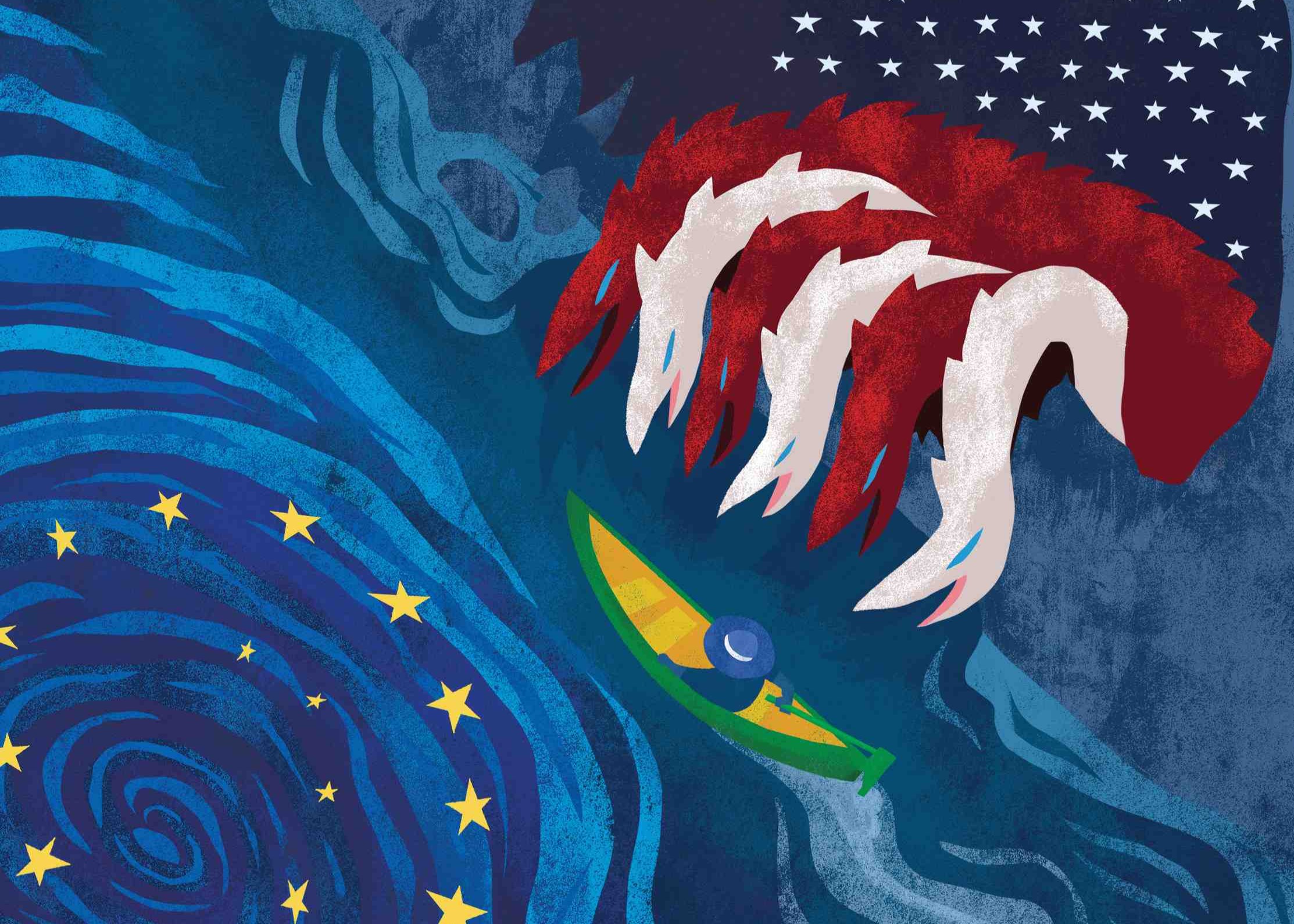
In Homer’s Odyssey, Ulysses must navigate a narrow strait between Scylla and Charybdis, two dangers from which there is no perfect escape. To avoid one is to risk the other. Survival depends not on choosing sides, but on skill, prudence, and the capacity to move forward despite unavoidable constraints. Brazil today finds itself in a comparable position–situated between two versions of the West, that is, one anchored in the United States and the other in Europe. One, represented by the aggressiveness of President Trump's agenda, and the other, by trying to find its autonomous place in the world. Brazil must chart a course through an increasingly fragmented and contested order represented by this ongoing split between two versions of the West.
The title of this issue, Brazil Between Two Wests, captures more than a geographical or diplomatic positioning. It reflects a deeper transformation in global politics. The transatlantic alliance that long structured Western cohesion has undergone visible strain, particularly during the presidency of Donald Trump, when longstanding assumptions about shared values, institutional commitments, and strategic alignment were openly challenged. Differences over trade, technology regulation, security priorities, and the future of multilateralism continue to shape an evolving and less cohesive West.
At the same time, the posture adopted by the United States during the Trump presidency can be interpreted as a departure from the normative foundations of the multilateral order. By privileging unilateral action, contesting multilateral institutions, and reframing international commitments in transactional terms, this approach evokes a more Hobbesian conception of international politics, one in which power prevails over rules, and legal constraints are subordinated to immediate national interest. For countries like Brazil, this shift raises important questions about the reliability of established norms and the risks associated with an increasingly law-fragmented global environment.
For Brazil, this fragmentation does not represent an anomaly, but rather a confirmation of a long-held view. Brazilian foreign policy has historically understood the international system not as a unified liberal order, but as a plural and fragmented environment composed of overlapping institutions, competing coalitions, and multiple normative frameworks. From this perspective, the current moment is less a rupture than an intensification of dynamics that have long defined global governance.
This interpretation has important consequences. If the international order is inherently plural, then rigid alignments become less desirable and less effective. Brazil’s diplomatic tradition has therefore emphasized autonomy, diversification of partnerships, and engagement across multiple institutional arenas. Rather than choosing between competing centers of power in the West or elsewhere, Brazil has sought to operate among them, expanding its room for maneuver while contributing to the construction of a more inclusive and diversified global order.
The metaphor of Ulysses is particularly apt because Brazil’s challenge is not simply to avoid risks, but to actively navigate them. The United States remains a central partner, offering deep ties in areas such as technology, investment, and political cooperation. Europe, in turn, represents a crucial interlocutor in matters of trade, regulation, climate governance, and multilateral diplomacy. Both poles are essential, yet neither can fully define Brazil’s international strategy.
The long-standing negotiations surrounding the EU-Mercosur Agreement offer a concrete illustration of both the potential and the limits of Europe as a partner for Brazil. On the one hand, the agreement reflects a shared commitment to trade liberalization, regulatory convergence, and environmental standards. On the other, its repeated delays and political contestation within Europe reveal the fragility of this commitment when confronted with domestic pressures and shifting priorities. For Brazil, the agreement thus embodies both opportunity and uncertainty, reinforcing the need to engage Europe pragmatically while avoiding overreliance on a partnership that remains contingent and politically contested.
Indeed, Europe has oscillated between defending the integrity of international law and accommodating its erosion through strategic silence or selective enforcement. While European actors frequently position themselves as guardians of multilateralism and normative order, their responses to breaches of international law have not always been consistent. This ambivalence reflects both internal divisions and the constraints imposed by geopolitical realities, but it also introduces uncertainty for partners such as Brazil, which must assess whether Europe can act as a stable normative anchor in a context of increasing global fragmentation.
The current international context makes this strategy both more necessary and more difficult. As geopolitical competition intensifies and pressures for alignment increase, the space for maneuver enjoyed by middle powers may narrow. In this environment, Brazil’s long-standing emphasis on multilateralism, negotiation, and institutional engagement becomes a valuable asset.
The contributions gathered in this issue explore these dynamics from multiple perspectives, examining Brazil’s relations with the United States and Europe in light of broader transformations in global order. Together, they suggest that Brazil’s challenge is not to choose between two Wests, but to redefine its engagement with both in a way that preserves autonomy while advancing its national interests.
Like Ulysses, Brazil cannot avoid the strait. But it can choose how to navigate it. The path forward lies not in rigid alignment or strategic isolation, but in a pragmatic and flexible diplomacy capable of operating across divides. By embracing its position as a pivotal State and by leveraging the plurality of the international system, Brazil can transform a landscape of risks into a field of opportunities.
In a world no longer defined by a single center of power or a unified set of rules, the ability to navigate between Scylla and Charybdis may well become the defining skill of successful foreign policy. Brazil, if it remains faithful to its diplomatic tradition while adapting to new realities, is well positioned to master this art.
DOI: https://doi.org/10.54827/issn2764-7897.cebri2025.16.01.01.12-15.en
Copyright © 2026 CEBRI-Journal. This is an Open Access article distributed under the terms of the Creative Commons Attribution License, which permits unrestricted use, distribution, and reproduction in any medium, provided the original article is properly cited.
