
-

-

-
 PT | EN
PT | EN 
A transformação da Venezuela dependerá de como as visões divergentes do chavismo e da oposição se articulam com os interesses e objetivos do governo Trump. Embora os Estados Unidos tenham desempenhado um papel decisivo no período posterior à captura de Nicolás Maduro, sua capacidade de determinar os rumos do país não é absoluta, e os desdobramentos desse processo ainda carecem de ampla aceitação entre os venezuelanos. Mudanças políticas duradouras dificilmente se consolidarão sem maior escrutínio e reconhecimento, tanto no âmbito doméstico quanto por parte de atores internacionais relevantes, como a União Europeia.
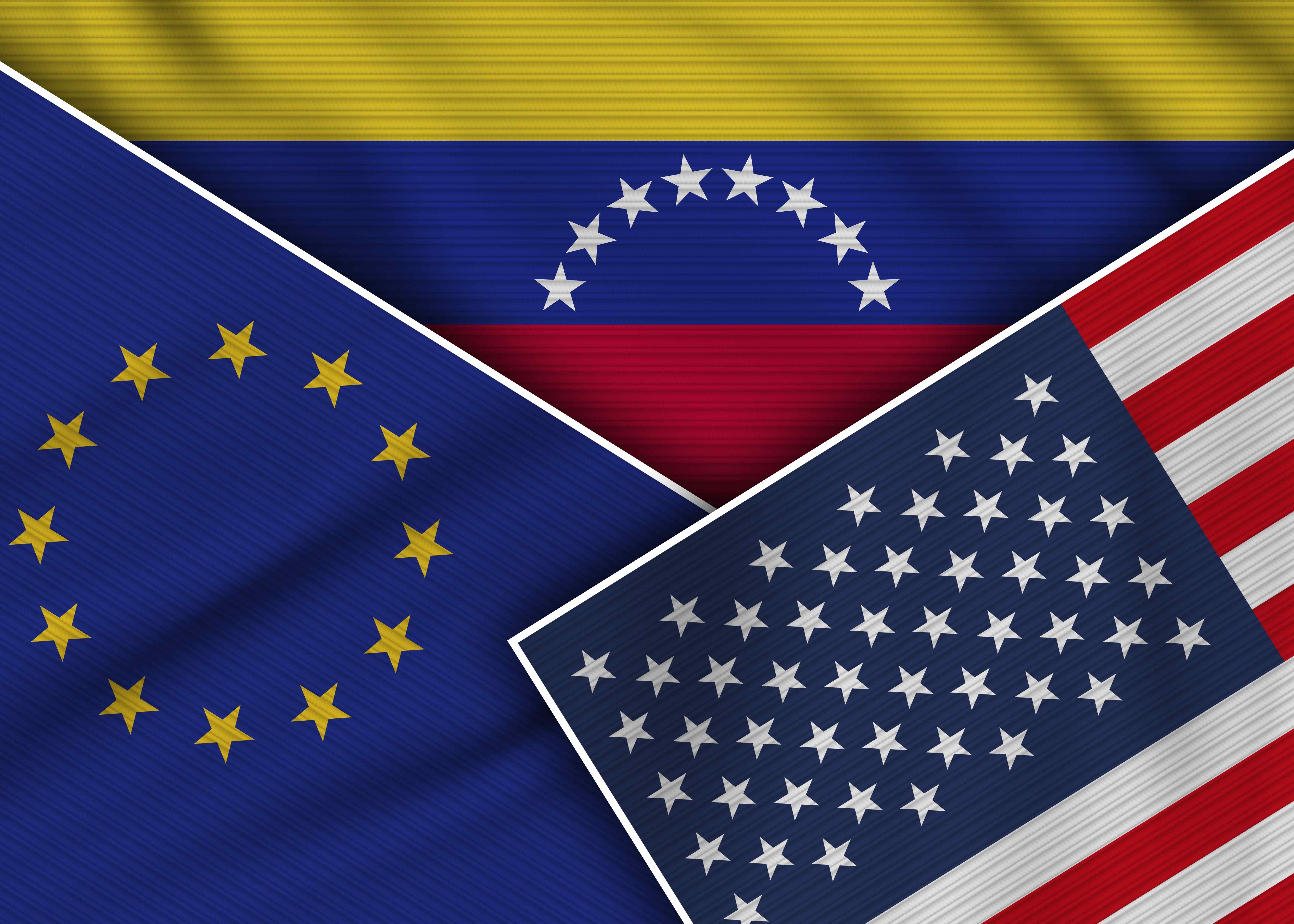
Venezuela’s current course is shaped primarily by decisions made by the Trump administration, especially its interpretation and implementation of the details of the three-stage plan: stabilization, economic recovery, and political transition. The framework’s broad scope makes its outcomes difficult to assess. The uneven and contested results of more than seven months of US-imposed protectorate-like subordination of the chavista regime headed by Delcy Rodríguez mainly concern the economy, particularly the oil and mining sectors. The economic sphere became even more relevant due to the aggravated humanitarian and financial costs of the disastrous twin earthquake in Venezuela on 24 June.
The third stage–political transition–remains the main source of uncertainty. The Trump administration is determining its direction, but its precise goals and the expected outcomes of regime-opposition negotiations are still unclear. However, the core political objectives of chavismo and the broader opposition are less ambiguous. The former generally seeks to retain power or, at a minimum, ensure its survival as a key political force, while the latter aims to dismantle the repressive system and restore democratic order and freedoms.
Venezuela’s stabilization, recovery, and normalization of international relations depend on reconciling the differences between chavismo and the opposition with the Trump administration’s interests and objectives for the country. Deep-rooted mistrust between these two Venezuelan sides, fueled by a history of unsuccessful or sham negotiation attempts, remains a major obstacle to a fair and lasting political reconstruction. The US likely has sufficient leverage to influence the process and compel both sides to reach a compromise. Still, while sidelining key and popular opposition figures such as María Corina Machado might facilitate an agreement, it may undermine the legitimacy of both the talks and their outcomes.
Currently, the US appears to guard the role of sole broker, using its position to further national political and business interests. Ultimately, the success of Venezuela’s political transition talks will be measured by the degree to which they are recognized by Venezuelan citizens and the broader international community, whose involvement should be integral to the transformation efforts in Venezuela.
US BROADER VISION
The Trump administration’s policy toward Venezuela reflects its larger perspective on the region and its ambition to reassert US dominance in the Western Hemisphere. The administration views Latin America and the Caribbean mainly as primary sources of security threats, such as irregular migration, transnational crime, drug trafficking, and the increasing influence of external rivals like China. It expects regional governments to cooperate in ways that serve US national interests (Znojek 2025).
The National Security Strategy (NSS), released in November 2025, together with references to the Monroe Doctrine and statements by US officials, outlines the Trump administration’s rationale and principles behind its pivot to the Western Hemisphere and its aggressive approach to Venezuela and other countries. The administration maintains that, for a major power like the US, strict adherence to non-interventionism is unrealistic and that greater influence by powerful countries is an inherent aspect of international relations. Simultaneously, it claims the US will seek constructive relations with other countries without imposing democratic reforms under the theme of “flexible realism.” The US pledges to reward governments that cooperate, align, or share its interests with the Trump administration. It also singles out military supremacy as key to achieving regional goals (White House 2025; Colby 2026; Hegseth 2026; Kozak 2026).
The armed capture of Maduro and his wife, followed by the subordination of the chavista regime under Delcy Rodríguez’s leadership, marked the most significant realization of US ambitions to regain dominance in the region (Mijares 2026; Kinstler 2026). Prior to the US military intervention in Caracas, the Trump administration justified its mounting pressure on Maduro by portraying him as a major threat due to his alleged role in drug trafficking. Afterward, the President cited access to Venezuela’s oil sector as his primary motivation (Trump 2026; US Department of State, 2026). Consequently, Trump’s central objective became opening the Venezuelan oil industry to foreign investment–especially for US companies (Kurmanaev, Page 2026)–highlighting his narrowly business-oriented approach to regional countries (Winter 2026a). Likewise, US Secretary of State Marco Rubio stated at the end of January that the US aimed to transform Venezuela from a “criminal State to a responsible partner,” with a key goal of preventing the country from serving as a hub for US adversaries such as China, Russia, and Iran (Rubio 2026).
The US-imposed transformation plan consists of three broad, somewhat ambiguous phases: stabilization, economic recovery, and political transition (Rubio 2026; Gunson 2026). The first phase was accomplished in principle through cooperation with the regime led by Delcy Rodríguez and by retaining Diosdado Cabello as head of the security apparatus, among other measures (Efecto Cocuyo 2026; Kurmanaev 2026). Opening the oil and mining sectors–especially oil, a major source of national income–was crucial for progressing to the recovery phase. However, the earthquakes on 24 June and the resulting reconstruction significantly complicated this process.
The third phase effectively began with the opposition-chavismo talks initiated in June and officially launched in early August. The US State Department described this dialogue as a path toward “institutional democratic transition,” with main objectives including strengthening democratic institutions, improving the electoral system, and restoring guarantees for political participation (State Department 2026b). However, the Trump administration’s approach is marked by its obstructive stance toward the opposition. It endorsed members of the National Assembly elected in 2015 as the legitimate opposition, arguing that this was the last Venezuelan body elected democratically and recognized by the US (Reverón 2026). The administration marginalized the popular María Corina Machado and her circle, who had led the opposition to victory in the 2024 presidential elections, which the Maduro regime falsified to secure his own reelection.
This approach appears to reflect the US desire for what Smilde (2026) calls a “smooth and low-cost transition.” By supporting a manageable opposition rather than the faction led by Machado, the Trump administration may seek to secure concessions and compromises in the talks with chavismo, including possible amnesty for regime members who have cooperated closely with the US. The administration may also wish to reduce the risk that decisions made by the regime under US supervision could later be contested by a future opposition-led government.
US arguments that it decided to keep the regime in place with Delcy Rodríguez and especially Cabello to avoid chaos after Maduro’s capture are plausible. Likewise, the Trump administration may have concluded it could achieve more for US interests with a subordinate regime than with a democratic government (Dąbrowski, Zaręba & Znojek 2026), particularly if María Corina Machado were to assume power. Consequently, a rapid democratic transition does not necessarily appear to be a US priority nor necessarily serves its interests.
Importantly, the US plan for Venezuela carries broader significance, as the Trump administration has presented it as a model approach for dealing with other autocratic countries. This heightens its eagerness to demonstrate success in Venezuela, proving that the US is the indispensable partner in economic recovery, fighting crime, or providing emergency aid, as in the case of the June earthquakes. Trump’s personal motivation should not be underestimated–his success in ousting Maduro helped overshadow his failure during his first presidential term, when Maduro withstood US pressure (Kurmanaev, Martínez & Pager 2026). Likewise, as Winter (2026b) asserts, Latin America is where Trump can demonstrate the greatest successes in advancing his policies and US interests.
CHAVISMO’S MAIN GOALS
US supervision presents both challenges and opportunities for chavismo’s internal reconfiguration and consolidation around renewed leadership. The governing “triumvirate”–as Efecto Cocuyo (2026) refers to Delcy Rodríguez, her brother Jorge Rodríguez (National Assembly leader), and Diosdado Cabello–is determined to survive, even if the political transition results in their loss of power. Chavismo’s primary goal remains to retain power or, failing that, to create conditions to quickly regain it (Bermúdez 2026).
Adapting to the new conditions required the chavista regime to shift from confrontation with the US to cooperation, despite years of anti-imperialism as a defining principle of Hugo Chávez Bolivarian revolution. This transition is complicated by differing reactions within chavismo. Martín (2026) writes about three main groups. The pragmatists, represented by the Rodríguez siblings, maintain strong rhetoric but are open to negotiation and change. The second group, the military, is mainly concerned with protecting its status, families, and assets. Finally, an ideological faction views US supervision as a threat to the revolution but prefers to remain low profile.
The regime appears to be balancing openness to cooperation with the US against efforts to control the pace and limit the scope of changes that might erode chavista control of the key State institutions. Delcy Rodríguez reportedly maintains direct contact with Rubio, consulting on decisions and receiving instructions, such as to remove officials linked to Maduro and his wife (Page & Kurmanaev, 2026). The chavista-controlled National Assembly has advanced bills on hydrocarbons and mining to allow private investment. The elimination of the Tren de Aragua gang founder in June illustrates counter-crime cooperation (Martínez 2026a).
Similarly, the regime apparently pretended to be ready to pursue national reconciliation and a political transition by announcing an amnesty law in February. However, implementation was apparently deliberately slow and selective, with a limited timeframe. While some prisoners were released, others were denied amnesty, transferred to house arrest, or left with other restrictive conditions. According to Foro Penal (2026), a Venezuelan NGO, over 380 political prisoners remained at the beginning of August, compared to 863 at the end of 2025. Despite US supervision, repression and political persecution persist (Martínez 2026a).
With US oversight, the chavista regime shows a willingness to engage in talks with the opposition but may attempt to delay the process, for example, by citing the opposition’s excessive demands. For chavismo, a clear red line will be the area of justice, with the risk of judicial prosecution for human rights abuses or crimes against humanity, especially if it loses institutional control and US protection. The regime may hope that prolonged negotiations increase the likelihood of regaining popularity and electoral viability. This scenario will become more likely if the economy improves or if political changes in the US result in a loosening of interest and control by the Venezuelan authorities (International Crisis Group 2026).
OPPOSITION PERSPECTIVE
US pressure on the Maduro regime and his eventual capture raised expectations among the democratic–but fragmented–opposition for dismantling the repressive system and restoring democracy. US control in Venezuela may help create fairer conditions for competition by preventing the chavista regime from blocking media access, prosecuting or arbitrarily detaining opponents, or imposing election bans–common tactics in the past. However, the Trump administration’s endorsement of a faction led by Dinorah Figuera, who presided over the opposition-controlled National Assembly elected in 2015, emboldens divisions among regime opponents and tests their ability to unite in advancing Venezuela’s redemocratization.
In July, after Figuera tried to present the process as inclusive and open to all democratic sectors, María Corina Machado and Edmundo Gónzalez Urrutia–the actual winner of the 2024 presidential elections–stated that they would neither participate in the dialogue nor obstruct the process (Machado & González Urrutia 2026).
Even after being sidelined by the US, María Corina Machado and the hardline option she leads remain the most influential opposition force. Paradoxically, she was one of the key advocates of the US decisive actions against Maduro and promised investment opportunities in oil, energy, and mining in a liberated Venezuela. She now faces a Trump administration pursuing those opportunities in cooperation with the chavista regime. Machado challenges this new arrangement by denying the legitimacy of decisions made under Delcy Rodríguez, arguing that the de facto authorities are corrupt and illegal because they usurped power following rigged elections (Gunson 2026).
In the Panama Manifesto, issued in May, Machado’s Democratic Unitary Platform (PUD) declared its main aim to be the restoration of democracy through the full liberation of all political prisoners, the safe return of Venezuelans exiled for political reasons, and the reconfiguration of the civilian-political space by dismantling the repressive apparatus. According to PUD, the talks with chavismo should aim for free presidential elections with all constitutional guarantees, but a parallel goal is to regain national trust and consensus to advance the democratic transition (Manifiesto de Panamá 2026). It also advocates an overhaul of the electoral system by elaborating an independent citizens’ register, reforming and renewing the National Electoral Commission (CNE), and abandoning the electronic voting system to prevent chavismo from rigging results (Picón Ball 2026).
Machado is arguably well placed to benefit from the ongoing opposition-chavismo talks (Martínez 2026b). If the results are inadequate or contested, Figuera will bear most of the blame. If free, guaranteed elections are achieved, Machado’s high popularity–72% compared to only 19% for Delcy Rodríguez in July (AtlasIntel & Bloomberg 2026)–could translate into the Peace Nobel laureate’s electoral success. For now, Machado’s main role seems to be keeping the democratic agenda alive, promoting scrutiny of US-regime cooperation, and rallying international support for Venezuela’s redemocratization.
THE ROLE OF INTERNATIONAL ACTORS SUCH AS THE EUROPEAN UNION
The US seeks to control which countries are involved in the transition, aiming to limit the influence of Maduro’s hitherto key allies–Cuba, China, Russia, and Iran. US openness to other international actors is not so obvious, and reconfiguration of Venezuela’s relations with other partners will be a major element of its current transformations. Similarly, those countries’ relations with Venezuela are a function of their relations with the US.
The European Union has long been an important extra-regional actor interested in stabilizing Venezuela and inducing the return of democracy. The International Contact Group, established in 2019, is a notable example of the EU efforts to facilitate dialogue between chavismo and the opposition. The EU has also imposed targeted sanctions, such as export restrictions and travel bans against the Maduro regime (Jütten & Delivorias 2026). In December 2025, it extended these measures–including those against Delcy Rodríguez–until January 2027 (European Council & Council of the EU 2025). Over the past decade, the EU has also provided nearly €590 million in humanitarian aid, including emergency support after the June earthquake (Kallas, Síkela & Lahbib 2026).
The EU response to US intervention in Venezuela reflected criticism of both the Maduro regime and the US approach. In a January statement, the EU called for a peaceful solution and respect for international law, reiterated its non-recognition of Maduro or Delcy Rodríguez as legitimate leaders, and urged a democratic transition and the release of political prisoners (European Council & Council of the EU 2025).
While Velasco Junior (2026) describes the EU approach as a “normative reaction,” in contrast with the “dilemma of alignment” of various countries with the US, the latter logic also matters in the EU response. Maintaining a strong relationship with the US, a key security and defense partner, remains essential for the EU. In recent years, it has prioritized these areas in response to Russia’s ongoing war against Ukraine and the rising threat visible in the increasing number of Russian sabotage and hybrid attacks in European countries (Bryjka, Dyner & Kozioł 2026). This context also explains the free trade concessions the EU offered the US in response to the Trump administration’s demands.
The EU position is further complicated by the contradictory effects of US policy in the Western Hemisphere. The US drive to regain dominance and disregard for international law undermines Europe’s refusal of Russia’s similarly revisionist and aggressive actions. Yet, US control over Venezuela could weaken Russia’s international disruptive outreach, potentially benefiting European interests. The EU cannot simply reject or confront US policy in the Americas, given its reliance on the US, unless the Trump administration crosses red lines, for example, by taking over Greenland by force.
THE WAY FORWARD
Venezuela’s path of transformation remains uncertain, even under ongoing US supervision and the three-stage plan it advances. Both chavismo and the opposition–whether engaged in dialogue or sidelined–will continue competing to shape the nation’s future and pursue their respective aims, including securing power within a reformed political system.
The US is eager to demonstrate the effectiveness of its policies in Venezuela, presenting it as a model for potential replication elsewhere. Marginalizing Machado may be less about her being an obstacle to democratic transition and more about the Trump administration’s desire for an uncomplicated path to success in Venezuela. In the US, pressure is increasing on the administration to speed up the transition, amid growing concern about the opacity of financial flows controlled by the US and their ultimate beneficiaries (Financial Times 2026; Dyer, Cook & Rodríguez Brazón 2026; Caracas Chronicles 2026).
Significant uncertainty surrounds the potential outcomes of the ongoing talks between chavismo and the opposition. At stake is not only the legitimacy of any agreement but also the durability of resulting changes. For example, it is unclear how lasting the shifts in US policy toward the Western Hemisphere will be, including the willingness to intervene militarily in the region. The upcoming US midterm elections in November will test the continuity of the current approach to Venezuela: if Democrats secure a majority, they could challenge or overturn the President’s decisions.
The complexity of the US-supervised transformation demands rigorous scrutiny. In Venezuela, independent media, NGOs, and opposition politicians are playing an increasingly active role in monitoring these developments. In the US, the opacity of the Trump administration’s involvement in Venezuela has also attracted bipartisan attention. Oversight from other international actors, including the EU, is also essential. Ultimately, the nature and quality of changes in Venezuela will affect its international recognition and ability to normalize relations. One important measure of progress will be whether a large proportion of the estimated eight million Venezuelans who fled the country in the past decade feel safe and hopeful enough to return.
Finally, beyond Venezuela’s case, aggressive US policies and a drive for supremacy in the Americas pose significant long-term risks to future regional relations. According to Winter (2026b), the rise of new influential anti-US politicians may be one consequence. The other is that the region will see consolidation of new authoritarian regimes led by leaders who currently benefit from US support or protection, as seen with El Salvador’s Nayib Bukele (Midziak & Znojek 2026).
References
Atlas Intel & Bloomberg. 2026. “Latam Pulse Venezuela. Julio 2026.” July 2026. https://atlasintel.org/b23b3049-0190-4209-a74a-c28cb34b0de7.
Bermúdez, Ángel. 2026. “Delcy y su gente están jugando a la supervivencia: cómo el chavismo se ha transformado durante 25 años para conservar el poder en Venezuela.” BBC News Mundo, 4 February 2026. https://www.bbc.com/mundo/articles/c5y2lwzgxqeo.
Bryjka, Filip, Anna Maria Dyner & Aleksandra Kozioł, “White Paper on Russian Acts of Sabotage and Subversion against Members of the Council of the Baltic Sea States.” PISM Report. The Polish Institute of International Affairs. May 2026. https://pism.pl/publications/white-paper-on-russian-acts-of-sabotage-and-subversion-against-members-of-the-council-of-the-baltic-sea-states.
Caracas Chronicles. 2026. “The Multi-Billion Dollar Black Box the US and Delcy Refuse to Open.” 23 July 2026. https://www.caracaschronicles.com/2026/07/23/the-billion-dollar-black-box-the-us-and-delcy-refuse-to-open/.
Colby, Elbridge. 2026. “Remarks by Under Secretary of War for Policy Elbridge Colby at the Conference of Defense Ministers of the Americas in Cusco, Peru (As Prepared).” 8 July 2026. https://www.war.gov/News/Speeches/Speech/Article/4538114/remarks-by-under-secretary-of-war-for-policy-elbridge-colby-at-the-conference-o/.
Council of the EU. 2025. “Council Decision (CFSP) 2017/2074 of 13 November 2017 Concerning Restrictive Measures in View of the Situation in Venezuela” (with further amendments). 15 December 2026. https://eur-lex.europa.eu/eli/dec/2017/2074/2025-12-17.
Dąbrowski, Andrzej, Szymon Zaręba & Bartłomiej Znojek. 2026. “The Significance and Implications of US Intervention in Venezuela.” PISM Spotlight. no. 1/2026. The Polish Institute of International Affairs. 5 January 2026. https://pism.pl/publications/the-significance-and-implications-of-us-intervention-in-venezuela.
Dyer, Geoff, Chris Cook & Ana Rodríguez Brazón. 2026. “The US Has Collected about $13bn of Venezuela’s Oil Money. Where Is It?” Financial Times, 22 July 2026. https://www.ft.com/content/0e562e03-106e-4729-83d7-675c27eb8c4d.
Efecto Cocuyo. 2026. “Chavismo disidente: El Rodrigato y Cabello buscan sacar provecho de la emergencia.” 26 July 2026. https://efectococuyo.com/politica/chavismo-disidente-rodrigato-cabello-provecho-emergencia-ya-es-tarde/.
European Council & Council of the EU. 2025. “Timeline – Venezuela”. 15 December 2026 ( last reviewed). https://skribi.consilium.europa.eu/en/policies/venezuela/timeline-venezuela/.
Foro Penal. 2026. “Presos políticos en Venezuela.” January 4 and July 27. https://x.com/ForoPenal.
Gunson, Phil. 2026. “The Venezuela Paradigm: Is Trump’s Model Intervention a Mirage?” International Crisis Group, 27 March 2026. https://www.crisisgroup.org/cmt/latin-america-caribbean/venezuela/venezuela-paradigm-trumps-model-intervention-mirage.
Hegseth, Pete. 2026. “Remarks by Secretary of War Pete Hegseth at the Americas Counter Cartel Conference (as Delivered).” US Department of Defense, 6 March 2026. https://www.war.gov/News/Speeches/Speech/Article/4424673/remarks-by-secretary-of-war-pete-hegseth-at-the-americas-counter-cartel-confere/.
International Crisis Group. 2026. “Venezuela’s Bonfire of Dogma: How Chavistas are Adapting to U.S. Domination.” Commentary, 22 May 2026. https://www.crisisgroup.org/cmt/latin-america-caribbean/venezuela-united-states/venezuelas-bonfire-dogma-how-chavistas-are-adapting-us-domination.
Jütten, Marc & Angelos Delivorias. 2026. “The US Military Intervention in Venezuela and the Regional and Geopolitical Context”. Briefing, European Parliament – European Parliamentary Research Service, no. OE 782.616, January 2026. https://www.europarl.europa.eu/RegData/etudes/BRIE/2026/782616/EPRS_BRI(2026)782616_EN.pdf.
Kallas, Kaja. 2026. “Statement by the High Representative on the Aftermath of the U.S. Intervention in Venezuela.” European External Action Service, 4 January 2026. https://www.eeas.europa.eu/eeas/venezuela-statement-high-representative-aftermath-us-intervention-venezuela_en.
Kallas, Kaja, Jozef Síkela & Hadja Lahbib. 2026. “Joint Statement by High Representative Kallas and Commissioners Síkela and Lahbib on the Devastating Earthquakes in Venezuela.” European Commission, 25 June 2026. https://civil-protection-humanitarian-aid.ec.europa.eu/news-stories/news/joint-statement-high-representative-kallas-and-commissioners-sikela-and-lahbib-devastating-2026-06-25_en.
Kinstler, Linda. 2026. “Is Venezuela a Colony Now? A Sovereign State? Modern Empires Rule in Ambiguity.” The New York Times Magazine, 17 July 2026. https://www.nytimes.com/2026/07/17/magazine/venezuela-empires-colony.html.
Kozak, Michael. 2026. “The National Security Strategy and the Western Hemisphere, Subcommittee Hearing.” Senate Foreign Relations Committee – Subcommittee on Western Hemisphere, Transnational Crime, Civilian Security, Democracy, Human Rights, and Global Women’s Issues, 14 July 2026. https://www.foreign.senate.gov/imo/media/doc/KozakTestimony_2026.pdf.
Kurmanaev, Anatoly, Mariana Martínez & Tyler Pager. 2026. “The Fall of a Strongman: Inside Maduro’s Last Days in Power.” The New York Times, 22 May 2026. https://www.nytimes.com/2026/02/25/world/americas/maduro-venezuela-us-capture-trump.html.
Kurmanaev, Anatoly. 2026. “He has a $25 Million Bounty on His Head. He’s Also a Key U.S. Partner.” The New York Times, 15 July 2026. https://www.nytimes.com/2026/07/15/world/americas/us-bounty-diosdado-cabello-venezuela.html.
Kurmanaev, Anatoly & Tyler Pager. 2026. “How Marco Rubio Is Running Venezuela from Afar.” The New York Times, 11 July 2026. https://www.nytimes.com/2026/07/11/politics/venezuela-marco-rubio.html.
Comando ConVzla. 2026. “Manifiesto de Panamá.” May 2026. https://x.com/ConVzlaComando.
Machado, María Corina & Edmundo González Urrutia. 2026. “María Corina Machado y Edmundo González a los venezolanos y la comunidad internacional.” X, 26 July 2026. https://x.com/MariaCorinaYA/status/2081484734002020568.
Martín, María. 2026. “Purgas internas y tutela externa: el chavismo reconstruye su fe sobre las ruinas de Maduro.” El País, 26 April 2026. https://elpais.com/america/2026-04-26/purgas-internas-y-tutela-externa-el-chavismo-reconstruye-su-fe-sobre-las-ruinas-de-maduro.html.
Martínez, Daisy. 2026a. “Seis meses sin Nicolás Maduro en el poder: ¿Qué ha cambiado en Venezuela?” Efecto Cocuyo, 5 July 2026. https://efectococuyo.com/politica/seis-meses-maduro-poder-cambiado-y-que-no-venezuela/.
Martínez, Daisy. 2026b. “Si la mesa tiene éxito, candidatura de Machado sale beneficiada: dicen analistas.” Efecto Cocuyo, 27 July 2026. https://efectococuyo.com/politica/mesa-exito-candidatura-machado-sale-beneficiada.
Midziak, Barbara & Bartłomiej Znojek. 2026. “International Echoes of El Salvador’s Public Security Model.” PISM Bulletin, no. 4 (2636), 23 January 2026. https://pism.pl/publications/international-echoes-of-el-salvadors-public-security-model.
Mijares, Víctor M. 2026. “Este es nuestro hemisferio.” La Silla Vacía, 7 January 2026. https://www.lasillavacia.com/red-de-expertos/red-de-venezuela/este-es-nuestro-hemisferio/.
Picón Ball, Cristóbal. 2026. “Maria Corina’s Pitch for Elections in Venezuela, Explained.” Caracas Chronicles, 17 June 2026. https://www.caracaschronicles.com/2026/06/17/maria-corinas-pitch-for-elections-in-venezuela-explained/.
Pigott, Thomas. 2026. “Supporting an Institutional Democratic Transition in Venezuela.” Press Statement, US State Department, 18 June 2026. https://www.state.gov/releases/office-of-the-spokesperson/2026/06/supporting-an-institutional-democratic-transition-in-venezuela/.
Pigott, Thomas. 2026. “Advancing Venezuela’s Institutional Democratic Transition.” Press Statement, US State Department, 16 July 2026. https://www.state.gov/releases/office-of-the-spokesperson/2026/07/advancing-venezuelas-institutional-democratic-transition/.
Reverón, Alejandro. 2026. “Two Parliaments and the Trump Administration Chart the Course Toward Transition.” Caracas Chronicles, 14 July 2026. https://www.caracaschronicles.com/2026/07/14/two-parliaments-and-the-trump-administration-chart-the-course-toward-transition/.
Rubio, Marco. 2026. “Secretary of State Marco Rubio Before the Senate Committee on Foreign Relations on U.S. Policy Towards Venezuela.” Foreign Relations Committee, January 28. https://www.foreign.senate.gov/hearings/us-policy-towards-venezuela.
Smilde, David. 2026. “Quick Reactions to the Figuera-Rodríguez Meeting and a Potential Dialogue Effort.” Venezuela and the United States, Substack, 19 June 2026. https://davidsmilde.substack.com/p/quick-thoughts-on-the-figuera-Rodríguez.
The White House. 2025. “National Security Strategy of the United States of America.” November 2025. https://www.whitehouse.gov/wp-content/uploads/2025/12/2025-National-Security-Strategy.pdf.
US Department of State. 2026. “Actions to Implement President Trump’s Vision for Venezuelan Oil.” February 13. https://www.state.gov/releases/office-of-the-spokesperson/2026/02/actions-to-implement-president-trumps-vision-for-venezuelan-oil/.
Velasco Júnior, Paulo Afonso. 2026. “A Wounded Hemispheric Order.” CEBRI Journal, no. 17 (January-March). https://cebri.org/revista/en/artigo/275/a-wounded-hemispheric-order.
Winter, Brian. 2026a. “Trump Is Remaking Latin America.” Foreign Affairs, July 9. https://www.foreignaffairs.com/americas/trump-remaking-latin-america.
Winter, Brian. 2026b. “What History Tells Us about Trump’s ‘Big Stick’.” Americas Quarterly, January 15. https://www.americasquarterly.org/article/what-history-tells-us-about-trumps-big-stick.
Znojek, Bartłomiej. 2025. “US Policy Towards Latin America Becomes More Aggressive.” PISM Bulletin. No. 34 (2535). https://pism.pl/publications/the-us-pursues-increasingly-aggressive-policy-towards-latin-america.
Submitted: August 13, 2026
Accepted for publication: August 15, 2026
DOI: https://doi.org/10.54827/issn2764-7897.cebri2026.17.02.04.75-88.en
Copyright © 2026 CEBRI-Journal. This is an Open Access article distributed under the terms of the Creative Commons Attribution License, which permits unrestricted use, distribution, and reproduction in any medium, provided the original article is properly cited.
